


Freud famously includes the Unconscious mind in his Psychodynamic Approach to Psychology. Along with his Tripartite Personality (ID, Ego & Superego) and the Influence of Childhood Experiences. All important according to Freud in how we shape our personality.
Typically Freud’s approach is looking at the past, such as how the Influence of Childhood Experiences shapes our behaviours. In coaching we tend to be more forward looking and solution focused, however there is a value in looking at the unconscious mind.
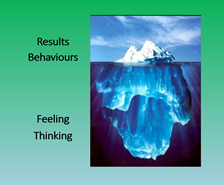
The image of an iceberg demonstrates Freud’s theory well. Freud said we can consciously and visibly see what’s above the water line such as our actions and behaviours, however underneath the water line is the unconscious mind and what we’re not consciously aware of. The feeling and thinking elements that can unconsciously drive what’s above the water line in our behaviours. So thinking I wish I could get more motivated to go out and get more clients, could unconsciously be driving our procrastination.
As coaches, asking effective questioning can help tap into the unconscious feelings and thoughts, that can help us be more aware of our behaviours and the results we really want.
Results – What results do you want to achieve?
Behaviours – What behaviours would you need to develop to get those results?
Feeling – What are the feelings/emotions that would help you to embrace those behaviours?
Thinking – What thoughts or beliefs would create those feelings?
As coaches we also have the benefit of coaching skills such as active listening – ICF Core Competency 5 – where we share with our coachee what we hear in their verbal and none verbal communication. This is often coming from the unconscious too.






Book recommendations too;
Body keeps the score – Kolk, Bessel van der
Games People Play – Berne
I’m OK – You’re – Harris
Great share GP thank you “Came across this the other day too…
https://youtu.be/m5L0T1eK07I